
How do you discern credible evidence from flawed research?
Have you wondered how to differentiate between rigorous evidence and sensationalised claims?
Do you want to feel confident in knowing if a study is high-quality versus highly-flawed?
It’s time to go beyond vague phrases like “studies show…” or“research says…”
It’s time to become truly confident and competent in your critical appraisal skills.
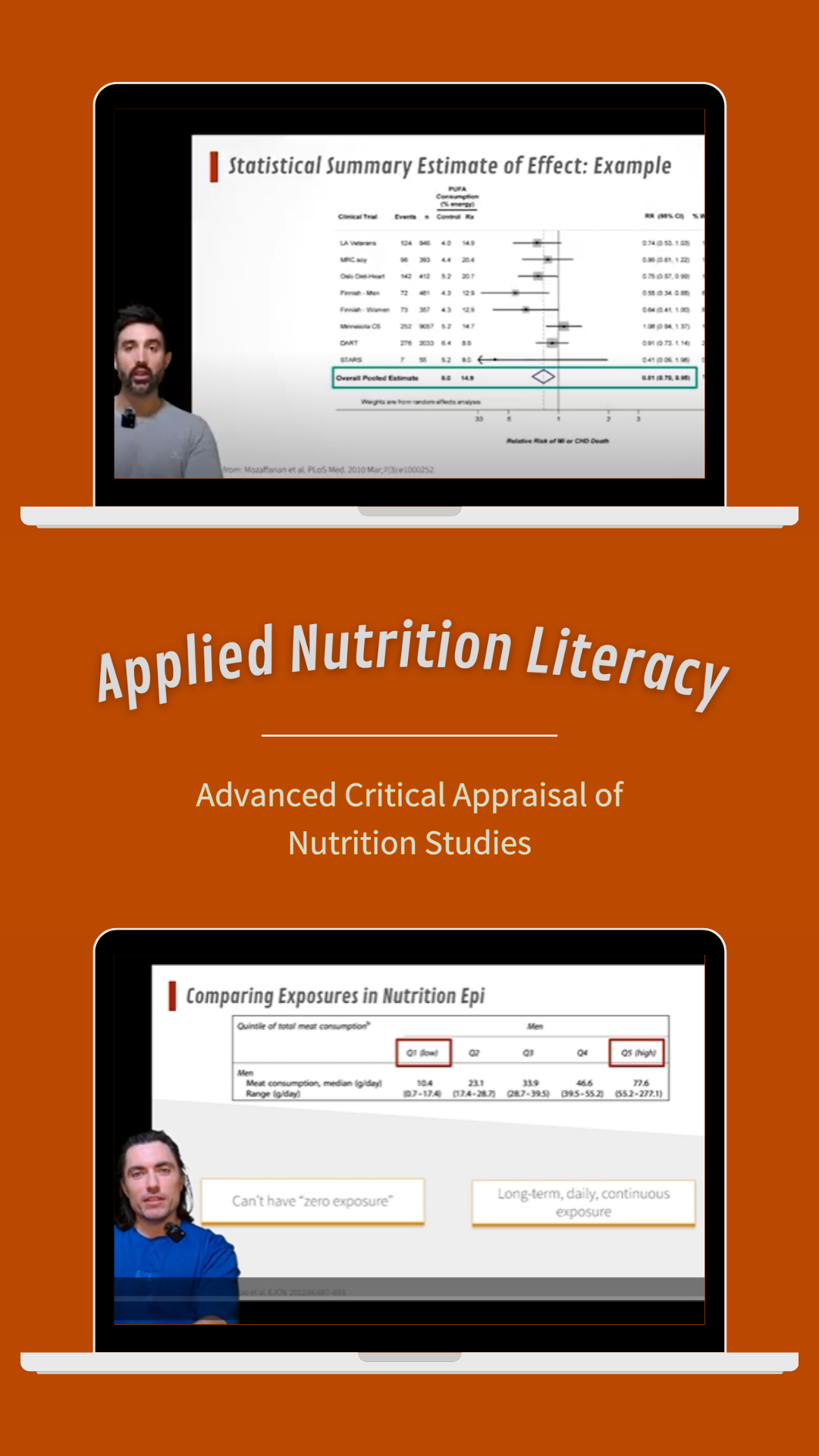
In an era dominated by pop-science podcasts and social media misinformation, such skills are more essential than ever.
Become a true scientific and critical thinker
Comprehensively understand research designs, methods and terminology
Critically appraise nutrition studies with real confidence
Skillfully interpret research findings and apply them in context

Danny Lennon has a master’s degree (MSc.) in Nutritional Sciences from University College Cork, in addition to an undergraduate (BSc.) degree in biology and physics.
Danny is the founder of Sigma Nutrition and for over 10 years has hosted the popular podcast Sigma Nutrition Radio, discussing topics related to nutrition science. He is also a respected educator in the health and fitness industry, having spoken at conferences and events all over Europe, as well as the United States and Australia.
Danny is currently a member of the Advisory Board of the Sports Nutrition Association, the global regulatory body responsible for the standardisation of best practice in the sports nutrition profession.

Dr. Alan Flanagan is a postdoctoral researcher at the University of Surrey. He holds a PhD in nutrition from the same institution.
Alan is the founder of Alinea Nutrition, an online education hub for nutrition and healthcare professionals.
Alan is also Research Communication Officer for Sigma Nutrition where he features as a co-host on the world’s leading evidence-based nutrition podcast.
Originally a lawyer by background in Dublin, Ireland, Alan spent a decade practising as a barrister before moving into science.
Got Questions? We’ve Got You Covered
This course is for those who want to be able to critically appraise nutrition research. This will include medical professionals, nutrition practitioners, nutrition science academics, and nutrition/health/medical students. However, it is also suitable for people outside of these professions who are keenly interested in nutrition science.
No. All of the core course lectures are pre-recorded so you can watch them whenever you want. However, the modules will become available on a schedule. But all the main course content is pre-recorded, and you don’t need to finish the course by a certain date, so you can study when it suits you!
Access to Module 1 will open on a Sunday.
Each subsequent module will be available every 1-2 weeks subsequently, depending on the module.
However, bear in mind that you don’t have to stick to this schedule. The course can be completed at pace that suits your learning preferences and professional/personal schedule.
Yes! We offer currently-enrolled students 20% off the normal price.
In order to get the discount:
Open this application form.
Upload your details and proof of registration.
Once we’ve received your application, we’ll email you details of how to avail of the student discount.
The course is a one-time payment of €679. Alternatively, you can choose to pay in two installments of €349. Students can get a discount of 20%.